
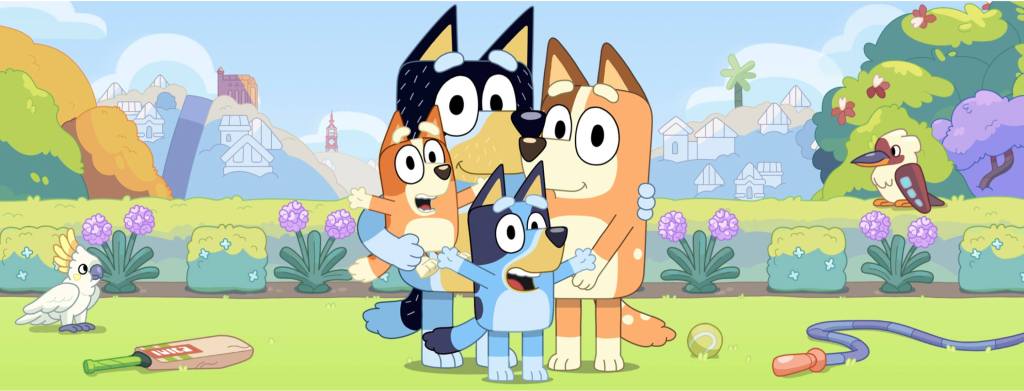
In the episode of Bluey called ‘Shadowlands’, Bluey and her friends, Coco and Snickers, are in the park playing an imaginary game which involves remaining, at all costs, on the shaded sections of grass, lest they (metaphorically) meet their gruesome death. Much to Bluey’s disapproval, Coco’s enthusiasm leads her to keep taking shortcuts, bending the rules as the game gets more difficult. Bluey is adamant that the rules can’t change, and it’s only in the final few minutes that Coco catches on to this too. Bluey exclaims, “The rules make it fun, Coco!” Amazing.
What is the message here? Coco thought that abandoning the rules would be more fun. More fun because it would be less difficult, and more fun because no rules would mean freedom to make up new rules – rules that she could choose herself.
Is that really freedom? Bluey doesn’t think so.
Pianos and Chequerboards
Bluey knows that the game becomes null and void once the rules are removed. There is no fun left once you remove rules, because the rules orient us within the game, and they define the game itself.
Let’s take the game of chess. If rules are factors that limit us, a ‘rule’ in chess is that I am not allowed to move diagonally with my rook. This rule limits my choices when it comes to my rook. If I am losing badly (as I usually am) I could easily abandon this rule and declare all rooks to be diagonal movers. I am free to do so, and it would definitely be easier for me to win. But in that instance, the game would no longer be a game of chess. It would be something else entirely, because in chess, the rook does not move diagonally. I might have a bit more fun for a while because I’ll have an easier time playing this new game with the rules I have made up (notice that my new game still needs rules, even if they are self-declared). But I am no longer playing the game of chess.
A game of chess is most fun when I have successfully check-mated my opponent within the limitations of the game – when I have won the game ‘fair and square’ – and as a culmination of what each player has (freely) chosen to do within these limitations. That’s chess, and that’s what makes it fun.
Another quick example – jazz. When a skilled jazz pianist improvises – that is, to create musical ideas spontaneously, in real-time, and play the keys freely without notated music – it is mesmerising. Here is a musician that appears to be unencumbered by the limits of, well, anything. Flying across the keys in perfect harmony, no notated music to distract them, and what seems like no tether at all to any music their fellow musicians seem to be continuing with underneath them.
But, similarly, jazz improvisation does not work without the limits (rules) of harmony, metre and probably most importantly, listening to others. If the same pianist was to abandon all of these things, playing anything at all at any speed they liked, just to make it a bit easier or to feel like they were truly free on the keys, you would be asking for your money back! It would be total chaos, and it would not be jazz anymore – just noise. The beautiful defining quality of jazz improvisation, in particular, is that it is music produced by freedom within a given set of rules. And this is what makes it fun to play and to listen to.
Our big ‘what’ and our big ‘why’
With these two analogies, it’s clear to conclude that when we abandon the rules of the game, two things happen. The first is that we loosen our grip on what we’re actually doing. Though we might think abandoning or changing the rules will help us be more free and have more fun, the result of this is actually chaos, which is not fun. If chess without chess rules isn’t chess, then what are we playing? If it’s not chess, then I have to figure out what it is.
The second is that we lose sight of why we’re doing what we’re doing. Abandoning the rules of the game, we fold up the OS map and venture into a no-man’s-land with very few obstacles but even fewer tangible reference points to actually orient ourselves and get to where we want to go. If jazz without any limits sounds dreadful, what’s the point? What is the purpose of it? If it’s not to sound beautiful, then I have to find another purpose to play it.
If we map this pattern onto the pursuit of personal freedom, we might conclude that abandoning ‘rules’ – that is, any external authority at all that might suggest how I should live my life – would be simultaneously abandoning my big ‘what’ and my big ‘why’. As human beings, this is an issue. If nothing is meaningful beyond me, and because I am hard-wired to find meaning in my existence, I have no other option but to answer the questions of what? and why? completely by myself. While this may masquerade as liberating, I will eventually get stuck in a feedback loop of my own ever-changing opinions and preferences, perpetually looking inwards for direction, and never being able to stand on any solid ground that can support my weight. I will constantly search for meaningful things that will validate who I am and why I am here, and I will be lonely, because those things cannot come from anyone or anything outside of my own self.
Communities will fragment and polarise. It will be exhausting. I will not be free.
So if that’s not freedom, then what is?
True Freedom
The gospel of John says this:
So Jesus said to the Jews who had believed him, “If you abide in my word, you are truly my disciples, and you will know the truth, and the truth will set you free.”
…
So if the Son sets you free, you will be free indeed.”
John 8:31-32, 36
If we take the Bible seriously, we will know the truth. And the truth will set us free. This freedom is brought about by the Son, Jesus, who walked this earth and went to a Roman cross to die before coming back to life. He did this in order to pay the debt that you and I owe for choosing our own ways each day. In this way, he has bought our true freedom, and it was a gift to us. It is available to you today.
How do we live out this true freedom?
You, my brothers and sisters, were called to be free. But do not use your freedom to indulge the flesh; rather, serve one another humbly in love. For the entire law is fulfilled in keeping this one command: “Love your neighbor as yourself.” If you bite and devour each other, watch out or you will be destroyed by each other.
Galatians 5:13-15
In this whole chapter, actually, we read that the Biblical definition of freedom is not the absence of limitation or responsibility but rather the living out the command to put others’ needs before our own. To abandon this command would not only be an active choice to oppose what is important to God but would also incite chaos. This pursuit of freedom will lead to destruction. True freedom – freedom in Christ – is actually pursued not by abandoning all the things we percieve to be oppressive and instead looking inward to our own needs, but instead by serving others humbly and putting others first before ourselves. True freedom is actually found by leaning in to the good commands and responsibilities we’ve been given, rather than trying to shake them off, and this includes surrendering to the Bible’s description of natural created order that does not oppress us, but truly liberates us.
Every1 wants 2 be free
A few years ago I walked past this graffiti on a wall just outside Glasgow. Spraypainted are the words ‘Every1 wants 2 be free’.
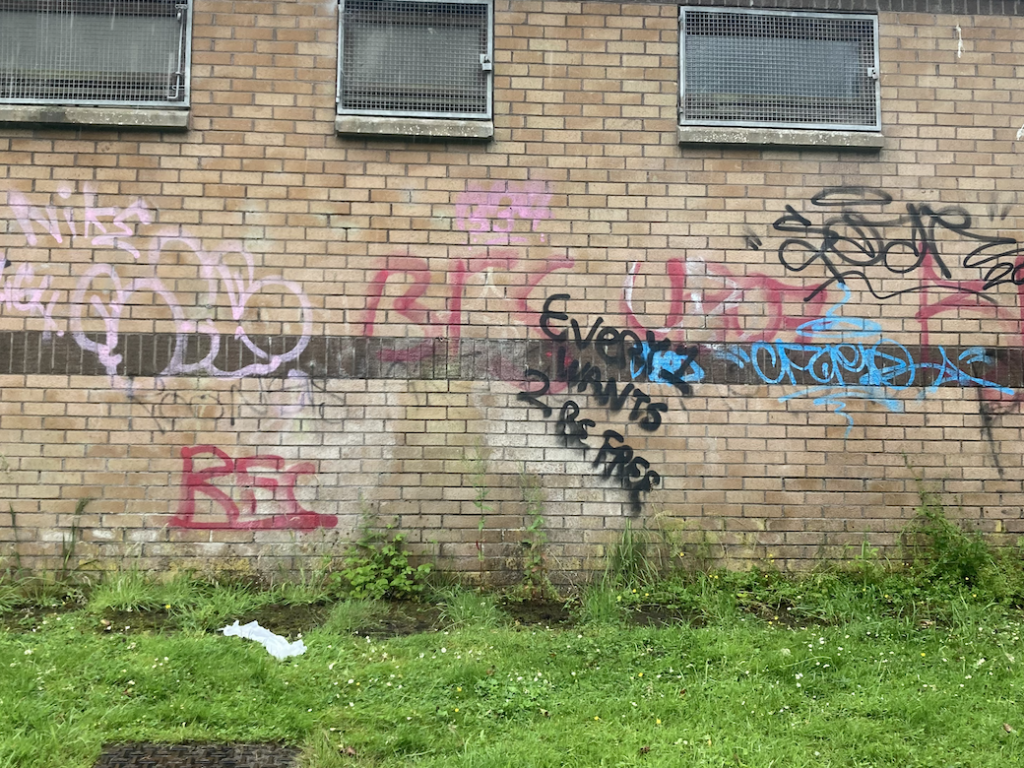
I took a photo because I agree. I believe it. Don’t you? We all want to be truly free.
Bluey was on to something! The rules help us make sense of the game. Christ’s truth, found in the Bible, helps us make sense of life – in fact, it is life-giving.
Look to Christ and know, truly and forever, your ‘what’ and your ‘why’. Stop searching inside yourself. Look to Christ, and be truly free.
 eilidh best
Leave a comment